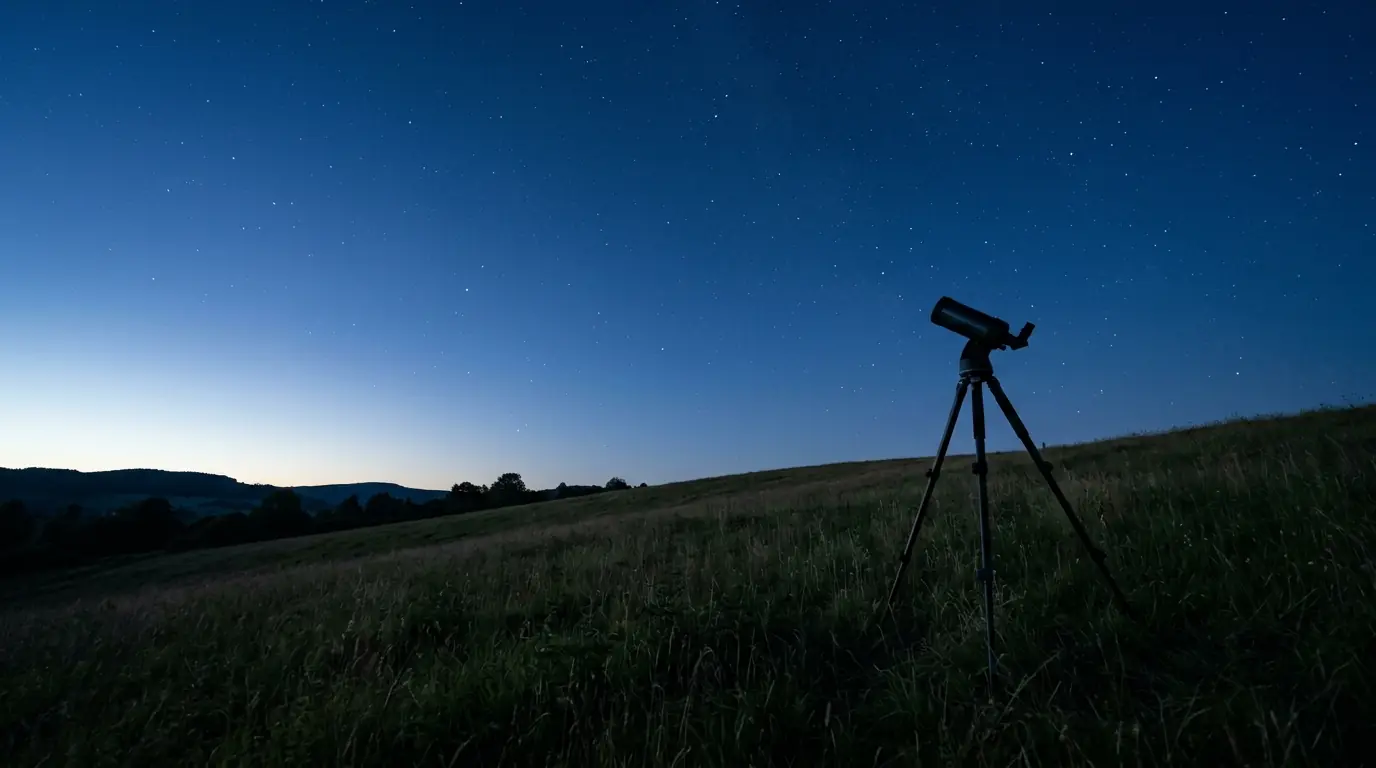
The night sky is the one view everyone shares, yet most people only ever see a handful of bright stars. The difference between a disappointing night and an unforgettable one is rarely the equipment. It is darkness, patience and knowing where to look.
Give your eyes time to adjust
Your eyes need time to reach full night vision. The US National Park Service, which runs night sky programs in its darkest parks, says it takes 20 to 30 minutes for the human eye to see its best in very low light. A single glance at a bright screen or a white flashlight undoes much of that.
- Use a red light to read charts or find your way, and keep it dim. You can cover an ordinary flashlight with red film.
- Turn your phone's brightness right down, use its night or red mode, or better still keep it in your pocket.
- Look slightly to one side of a faint object. The edge of your vision is more sensitive in the dark, a trick astronomers call averted vision.
Get away from the lights
Light pollution is the biggest obstacle for modern stargazers. A 2016 world atlas of night sky brightness found that the Milky Way is hidden from more than a third of humanity, including nearly 80% of North Americans.
You do not need a remote desert. Even a park, beach or field on the edge of town, away from direct streetlights, shows noticeably more stars. Light pollution maps help you find the darkest spot within driving distance, and officially recognized dark sky parks are worth a trip for a special night.
If you are stuck in a city, do not give up: the Moon, the bright planets and the brightest stars and star clusters all shine through light pollution.
Plan around the Moon
The Moon is both a target and an obstacle.
- For faint stars, the Milky Way and galaxies, choose nights around the new Moon, when the sky is darkest. A full Moon washes out almost everything else.
- For the Moon itself, the best views come in the days after new Moon through to just past first quarter, and again before last quarter. The shadows along the line between day and night make craters and mountains stand out. A full Moon looks flat, because the sunlight hits it head-on.
What you can see with just your eyes
NASA points out that for most people, our own eyes are often the best way to enjoy the sky. Without any equipment you can see:
- Five planets: Mercury, Venus, Mars, Jupiter and Saturn are all visible without a telescope when they are well placed.
- The International Space Station, a bright, steady light crossing the sky in a few minutes. NASA's Spot the Station service tells you when it passes over you.
- Meteor showers, best enjoyed, as NASA suggests, by simply lying down and looking up.
- The Milky Way, from a dark site on a moonless night, especially in summer and early autumn in the Northern Hemisphere.
Start with binoculars
NASA calls binoculars an excellent first instrument for skywatching because they are easy to use and more versatile than most telescopes. A pair labeled 7x50 or 10x50 (the first number is the magnification, the second the lens width in millimeters) gathers plenty of light while staying steady enough to hold.
Good first targets include the Moon's craters, Jupiter's four largest moons, the Pleiades star cluster, the Orion Nebula and, from a dark site, the Andromeda Galaxy. Resting your elbows on a car roof or a fence, or using a tripod adapter, makes the view much steadier.
When a telescope makes sense
A telescope shows Saturn's rings, cloud bands on Jupiter and far more detail on the Moon, but a traditional telescope takes practice: you need to learn the sky to find faint targets and set up carefully each night.
Smart telescopes take a different approach. You control them from a phone app, they find targets automatically, and a built-in camera collects light over several minutes and combines the frames into a picture. That reveals the colors and shapes of nebulae and galaxies that the eye cannot see even through a large telescope, and it works surprisingly well from light-polluted suburbs.
Plan your night
- Check the weather and the Moon. Clear-sky forecasts made for astronomers show cloud, transparency and steadiness hour by hour.
- Use a sky app or star chart. Apps show what is above you in real time; set them to night mode.
- Dress warmer than you think. Standing still at night is cold, even in summer. Bring a chair, a blanket and a warm drink.
- Learn a few bright patterns, such as the Big Dipper or Orion, and use them as signposts to find everything else.
Frequently asked questions
What is the best time of month to go stargazing?
Around the new Moon, when the sky is darkest. For viewing the Moon itself, choose the week after new Moon, when its craters show the most relief.
Can I see planets without a telescope?
Yes. Mercury, Venus, Mars, Jupiter and Saturn are all visible to the naked eye when they are well placed. They shine with a steadier light than stars.
Are binoculars or a telescope better for beginners?
Binoculars are the easier start: they are cheap, portable and show far more than your eyes alone. A telescope, or a smart telescope, is the next step once you know what you want to see.
Sources
- Skywatching, NASA Science
- Night sky viewing: etiquette and advice, US National Park Service, Joshua Tree National Park
- The new world atlas of artificial night sky brightness, Falchi et al., Science Advances (2016)
- 10 tips for observing the Moon, Astronomy magazine