A sparkling pool is not luck. It is the result of three jobs done regularly: circulation (moving the water through the filter), cleaning (removing leaves, dirt and anything that settles) and chemistry (keeping the water sanitized and balanced). When one slips, the others have to work harder, and that is when water turns cloudy or green.
This guide explains each job in plain English, then puts them together into a routine you can actually keep.
How a pool stays clean
Circulation and filtration
Your pump pulls water from the skimmers and main drain, pushes it through the filter and sends it back through the return jets. Water that is not moving is where algae and cloudiness begin, so the goal is to filter the whole pool regularly.
Pool professionals talk about turnover: the time it takes to push the pool's full volume through the filter once. You can work it out yourself:
Turnover time (hours) = pool volume (gallons) ÷ (pump flow in gallons per minute × 60)
Most owners run the pump long enough for at least one full turnover a day, and longer in hot weather or when the pool is busy. A variable-speed pump can run for longer at a lower speed, which usually uses less electricity for the same amount of filtering.
The filter itself needs attention too. As it traps dirt, the pressure on the filter gauge rises. Your filter's manual tells you when to backwash or clean the cartridge, usually once the pressure has climbed a set amount above its clean starting point.
Cleaning
Filtration catches what floats past the skimmer, but a lot of debris sinks or sticks:
- Skim leaves and insects off the surface before they sink and stain.
- Empty the skimmer and pump baskets so water can flow freely.
- Brush the walls, floor and steps. Algae starts in corners and on steps where circulation is weakest, and brushing knocks it loose before it takes hold.
- Vacuum the floor to remove the fine dirt the filter cannot reach.
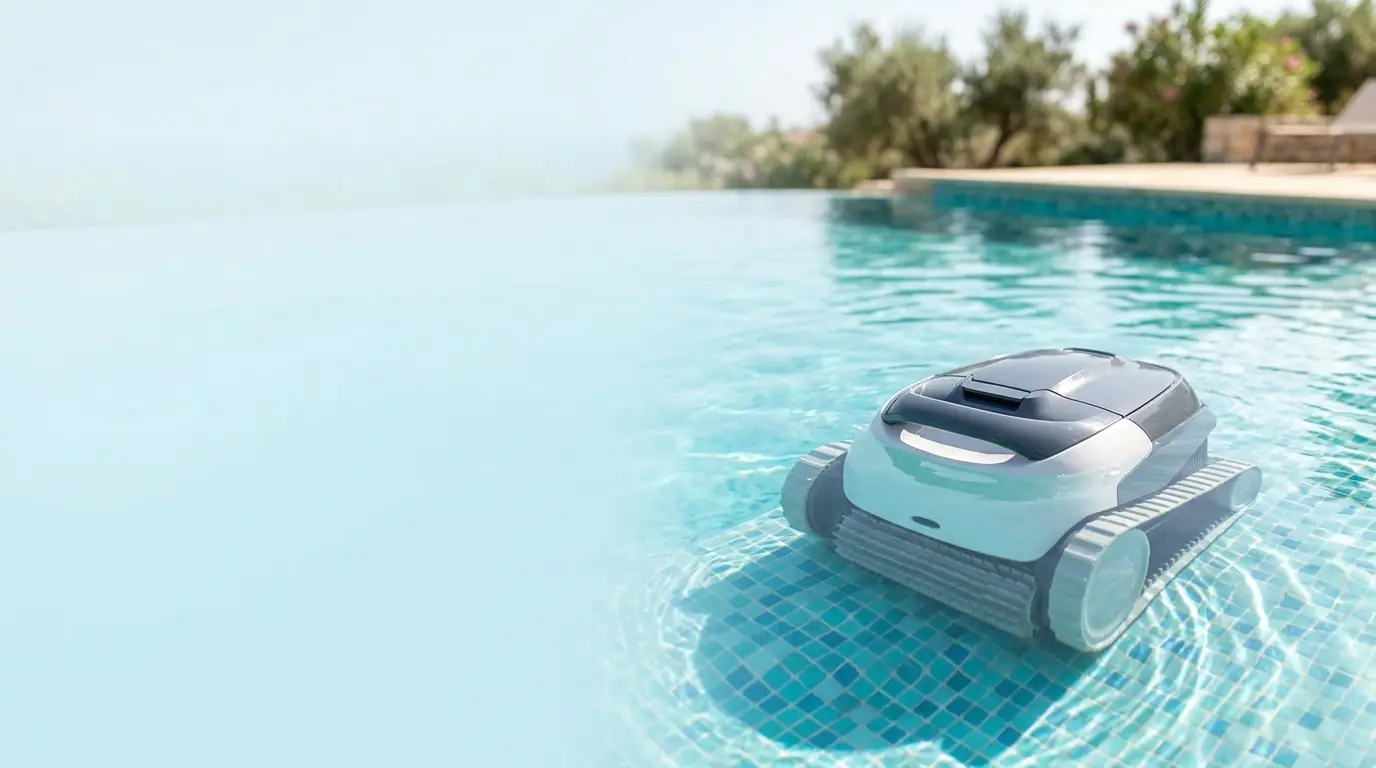
Vacuuming by hand is the slowest part of pool care, which is why many owners use an automatic cleaner. Suction-side cleaners connect to your skimmer and use the pump's suction, pressure-side cleaners are driven by water from a return jet, and robotic cleaners have their own motor and filter, so they work independently of your pool's equipment. Robotic models are the most expensive, but many can also climb walls and scrub the waterline.
Water chemistry
Clean-looking water can still be unsafe, so testing matters as much as cleaning. The two numbers that matter most are your sanitizer level and pH.
| What to test | Target | Why it matters |
|---|---|---|
| Free chlorine | At least 1 ppm (at least 2 ppm if you use stabilizer) | Kills germs and stops algae |
| pH | 7.0 to 7.8 | Chlorine works poorly at high pH; low pH corrodes equipment |
These targets come from the US Centers for Disease Control and Prevention (CDC), which also notes that stabilizer (cyanuric acid) protects chlorine from sunlight but makes it slower to disinfect. The CDC advises testing chlorine and pH at least twice a day, and more often when the pool is busy, and suggests a DPD test kit for accurate readings.
Other measurements, such as total alkalinity, calcium hardness and stabilizer level, keep pH steady and protect your pool's surface. Your test kit and your pool builder or equipment maker will give the ranges that suit your pool type (vinyl, plaster or fiberglass) and sanitizer.
A simple pool care routine
Every day
- Check that the pump is running and water is flowing from the returns.
- Skim the surface and glance at the water: it should be clear enough to see the drain.
- Test free chlorine and pH, and adjust if needed.
Every week
- Empty the skimmer and pump baskets.
- Brush the walls, steps and floor.
- Vacuum, or run your automatic cleaner.
- Check the filter pressure and note it.
- Test total alkalinity and the other values your kit covers.
Every month, or as your manuals say
- Backwash or clean the filter when the pressure reading tells you to.
- Inspect the pump, hoses and fittings for leaks or cracks.
- Clean your automatic cleaner's filter and check its brushes or tracks.
Fixing common problems
Green water means algae has taken hold, usually because chlorine dropped too low or circulation was poor. Brush every surface, raise the chlorine level following your product's instructions (often called shocking), run the filter continuously and clean it as it clogs. Keep testing until the chlorine level holds.
Cloudy water usually points to filtration or balance. Check that the pump runs long enough, clean the filter, and test chlorine and pH. Very fine particles can take a day or two of filtering to clear.
A strong "chlorine" smell is often a sign of chloramines, which form when chlorine combines with sweat, urine and other waste from swimmers. It usually means the pool needs more free chlorine, not less, and showering before swimming helps.
Using pool chemicals safely
Pool chemicals send thousands of people to emergency rooms in the US each year, and the CDC says most injuries happen at home. Its advice is simple:
- Never mix different pool chemicals, especially chlorine and acid, which can release toxic chlorine gas.
- Add chemicals to water, never water to chemicals.
- Open one container at a time, and close it before opening another.
- Wear safety glasses and gloves, and read the full label first.
- Store chemicals cool, dry, well ventilated, out of direct sunlight, in their original labeled containers, and locked away from children and pets. Keep acids and chlorine apart.
Opening and closing for the season
If you close your pool for winter, balance the water first, clean it thoroughly, lower the water level as your pool type requires and protect the plumbing from freezing. When you reopen, clean and balance before swimming: it is much easier to start the season with clear water than to rescue a green pool in June.
Frequently asked questions
How long should I run my pool pump each day?
Long enough to filter the whole pool at least once, using the turnover formula above. Run it longer in hot weather, after heavy use or when the water looks dull.
How often should I shock my pool?
Whenever testing shows your free chlorine has dropped too low, after heavy use or a storm, and whenever algae appears. Follow the instructions on the product you use.
Do I need an automatic pool cleaner?
No, but it saves the most time-consuming job. If you vacuum by hand every week, an automatic cleaner, and especially a robotic one, gives you that time back and keeps the floor cleaner between visits.
Sources
- Home pool and hot tub water treatment and testing, US Centers for Disease Control and Prevention
- Pool chemical safety, US Centers for Disease Control and Prevention
- Pool chemical injuries in public and residential settings, 2008–2017, CDC Morbidity and Mortality Weekly Report